
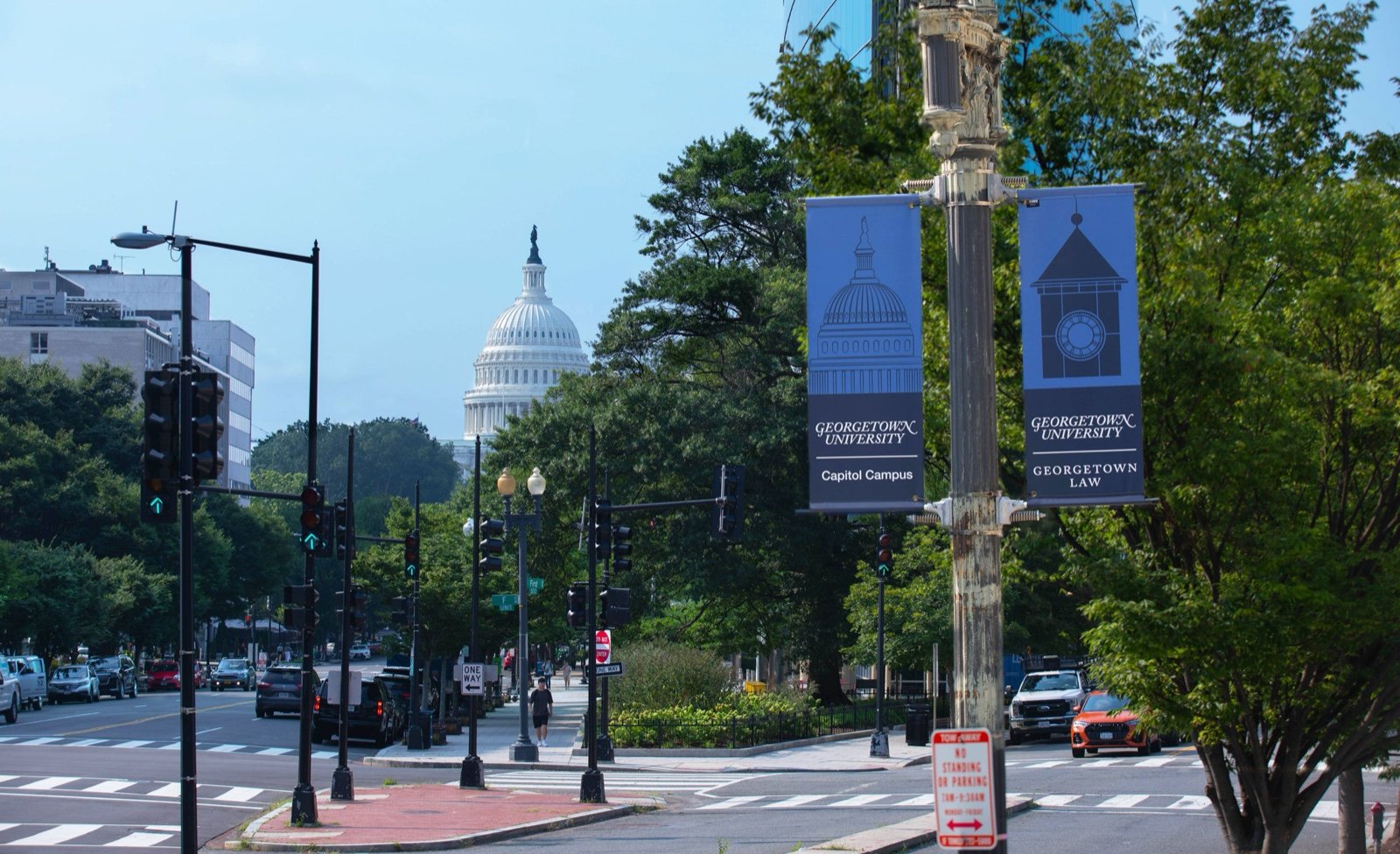
Photo: Georgetown University Law Center.
Seven members of Georgetown University Law Center's class of 2026 have won the two most prestigious public-interest fellowships in American law: five Equal Justice Works Fellowships and two Skadden Fellowships. Georgetown announced the cohort on 2 July 2026. Between them, the seven will spend the next two years working on homelessness, environmental justice, disability rights, immigration, juvenile justice, and access to health care, from Louisiana to New York. Our congratulations to all seven, and to the school.
"In what has been a challenging year for our students committed to pursuing public interest paths, it has been deeply meaningful for OPICS to have the opportunity to support this year's applicants as they developed their fellowship projects," said Morgan Lynn-Alesker, Georgetown's Assistant Dean for Public Interest Programs and herself a 2007 graduate of the Law Center. OPICS, the Office of Public Interest and Community Service, works with students each year on their fellowship proposals.
The Skadden Fellows
Two graduates were named Skadden Fellows:
- Zoe Ades will work at the ACLU Trone Center for Justice and Equality, challenging the criminalization of homelessness and fighting for the rights of unhoused people. She credits her time as a student attorney in Georgetown's Appellate Courts Immersion Clinic for preparing her.
- Susie Powell will work at the Centro de los Derechos del Migrante, representing immigrant clients who work across several states, with time at the organization's offices in Mexico City and Oaxaca. She points to Georgetown's asylum clinic, the Center for Applied Legal Studies, as her formative experience.
The Equal Justice Works Fellows
Five more graduates were named Equal Justice Works Fellows:
- Raissi Bysiewicz joins Rise St. James, a grassroots environmental-justice organization, to represent communities in Southeast Louisiana. She prepared in Georgetown's Environmental Law and Justice Clinic.
- Cole Miller heads to the Minnesota Disability Law Center to represent students with disabilities in due-process hearings and to build know-your-rights trainings that outlast his project.
- Molly Pifko joins the Legal Aid Justice Center in Northern Virginia, working on health-harming legal needs and supporting Medicaid and SNAP recipients.
- Elizabeth Ratcliffe joins the Legal Aid Society's Juvenile Rights Practice, representing young people navigating New York's parole system.
- Emily Volk returns to the Georgetown University Health Justice Alliance and its Cancer LAW Project, working to remove legal barriers for cancer patients in Washington, D.C.
A clinic-to-fellowship pipeline
One thread runs through all seven projects: Georgetown's clinics. Every fellow traced their readiness to a specific clinical experience, the Appellate Courts Immersion Clinic, the Environmental Law and Justice Clinic, the Center for Applied Legal Studies asylum clinic, the Juvenile Justice Clinic, and the Health Justice Alliance among them, and Cole Miller pointed to a due-process hearing simulation taught by Professor Kathryn Pincus. "Without a doubt, clinic prepared me the most for this fellowship," Susie Powell said. Georgetown Law runs one of the largest and oldest in-house clinical programs in the country, and this cohort is a direct product of it: two of the fellows, Molly Pifko and Emily Volk, came through the school's own Health Justice Alliance, and Volk is returning to the clinic partner where she externed.
What a Skadden Fellowship is
The Skadden Fellowship is run by the Skadden Foundation, launched in 1988 by the law firm Skadden, Arps, Slate, Meagher & Flom to mark its 40th anniversary. Often called "the legal Peace Corps," a nickname popularized by the Los Angeles Times, it gives recent law graduates two years of funding to practice public-interest law full time, addressing the unmet civil legal needs of people living in poverty, at a host organization the fellow helps design their project around. It is widely regarded as the single most competitive postgraduate public-interest fellowship in the United States; the 2026 class numbers 34 fellows drawn from 20 law schools nationwide, and the Foundation has funded more than a thousand fellows since it began.
What Equal Justice Works fellowships are
Equal Justice Works, a nonprofit founded in 1986, runs the country's other flagship public-interest fellowship. Under its design-your-own model, an applicant and a host organization jointly design a two-year project to meet an unmet legal need, and Equal Justice Works pairs the fellow with a sponsor, a law firm, company, or foundation, that funds the position. It awards several dozen such fellowships each year and supports its fellows with a salary, loan-repayment assistance, training, and a national alumni network.
Why it matters
Between them, Skadden and Equal Justice Works are the two main gateways into a public-interest legal career: each lets a new lawyer launch a self-designed, two-year project with real funding behind it, rather than waiting for a job to open up. Winning seven in a single year, across homelessness, the environment, disability, immigration, juvenile justice, and health, is a strong showing for a school long known for the depth of its public-interest program, and it comes in a year its own dean describes as a difficult one for students committed to that work.
For Georgetown law students
Georgetown students and alumni can search legal jobs and internships worldwide on LegalAlphabet, including the public-interest and government roles the school is known for. See legal jobs in the District of Columbia, browse current openings on the United States legal jobs board, or read more from our Law School News desk.
Sources
This report is based on the announcement published by Georgetown University Law Center, with additional background from the Skadden Foundation and Equal Justice Works. Quotations are drawn from the Georgetown announcement.
Has your law school's student, graduate, or faculty member done something worth celebrating, a fellowship, a clerkship, a competition win, an appointment? Tell us and we will put it on the record.