
On 7 June 2000, a federal judge in Washington ordered that Microsoft, then one of the most valuable companies in the world, be broken into two. The government had accused it of running an illegal monopoly, and for once the charge had stuck at trial. The company that had won almost every market it entered was, on paper, about to be dismantled by the state. Standing between Microsoft and that fate was its chief lawyer, a courtly Seattle litigator who held a conviction unusual for a man in his position: that the law is not merely a weapon to be wielded for a client, but a public trust that holds a society together. He appealed, and within a year he had the breakup reversed. Then, having spent nearly a quarter of a century defending the hardest-charging company of the software age, he gave much of the rest of his life to a single idea, that the rule of law must belong to everyone and not only to those who can afford the best counsel.
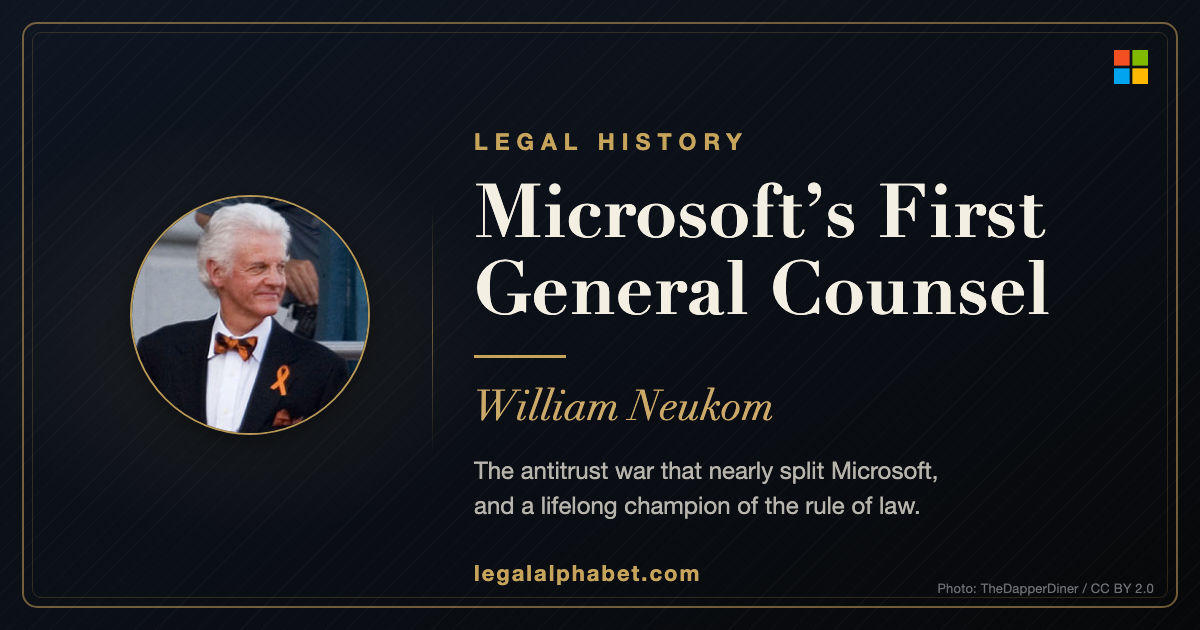
His name was William Neukom, and he was Microsoft's first General Counsel. His career is one of the most complete in the history of in-house practice, because it contains both halves of what a great lawyer can be: the fierce advocate who will fight the government to a standstill for his client, and the public citizen who believes the whole system has to be fair or none of it means anything. This is a profile for lawyers: who he was, what he actually did, the landmark matters that crossed his desk, and what his life still teaches anyone who wants the office of General Counsel to stand for something.
This is a historical profile compiled from the public record, including court decisions, company announcements and reporting. Where accounts differ, that is noted. Nothing here is legal advice.
The trick question: who was Microsoft's first lawyer?
Ask "who was Microsoft's first lawyer?" and the answer contains a piece of history almost too neat to be true. When Bill Gates and Paul Allen founded Microsoft in 1975, the first lawyer the young company leaned on was, in effect, kept in the family. Gates's own father, William H. Gates Sr., was a respected Seattle attorney, and it was his firm that gave the tiny software venture its early legal counsel.
A partner at that firm took the fledgling company on as a client in the late 1970s, when Microsoft had barely a dozen employees and the personal computer was still a hobbyist's curiosity. His name was William Neukom. For six years he served Microsoft as outside counsel, watching it grow from a curiosity into a force. Then, in 1985, he left the firm to go in-house and become Microsoft's first General Counsel.
There is a lesson in that arrangement that every founder and every young lawyer should sit with. Microsoft did not hire a General Counsel because it had a legal problem. It hired one because it intended to become an institution, and institutions need a lawyer who belongs to them, who sits in the room where strategy is set, and who will still be there when the easy years end. The company that makes that hire early, before the crisis, is the company that survives the crisis. Microsoft was about to have some of the largest legal crises in corporate history, and the lawyer to meet them was already inside.
The making of the lawyer

William Horlick Neukom was born in Chicago on 7 November 1941. He took his undergraduate degree at Dartmouth College and then his law degree at Stanford, graduating in 1967, before settling into practice in Seattle. That geography mattered. Seattle in the 1970s was not a legal capital, but it happened to be the home of a family whose son would change the world, and Neukom's firm happened to be the one that family trusted.
The temperament mattered as much as the location. Tall, famously dapper and known for the bow ties he made look effortless, Neukom carried a reputation for integrity and an old-school seriousness of purpose, and a conviction that how a lawyer conducts a fight is inseparable from whether the lawyer deserves to win it. That is not a soft quality in a General Counsel. It is the quality that lets a company be represented aggressively without being represented disgracefully, and it is the quality that would, decades later, turn a corporate litigator into a global champion of the rule of law. The values were there long before the platform to express them.
Building the house
When Neukom became General Counsel in 1985, Microsoft's legal function was a handful of people. By the time he retired in 2002 it numbered in the hundreds, a department of roughly six hundred lawyers and staff that was, in the words of Steve Ballmer, one of the most respected and capable legal and corporate affairs operations anywhere. Neukom had spent, as Ballmer put it, nearly a quarter of a century as an extraordinary part of Microsoft's success.
Understand what that means in practice. A General Counsel who builds a department from five people to six hundred is not simply hiring lawyers. He is designing how a company thinks about risk, how it makes promises, how it treats regulators, how it competes at the edge of what the law allows. He is building the machinery that will either save the company or fail it when the reckoning comes. Neukom built for scale and for war, and both turned out to be necessary.
The first great fight: Apple v. Microsoft
Long before the government came for Microsoft, a competitor did. In 1988 Apple sued Microsoft, alleging that the graphical look and feel of Windows infringed the visual copyrights of the Macintosh. It was one of the defining intellectual-property battles of the early software industry, and Neukom's department led Microsoft's defense.
Microsoft largely prevailed. The courts held that most of the disputed visual elements were either licensed or not protectable, and by the mid-1990s the case was effectively over in Microsoft's favor. Readers of this series will recognise the other side of that story: the same 1985 licence that Apple's own lawyers had drafted came back to defeat Apple's claim, a saga we told in our profile of Apple's first General Counsel, Al Eisenstat. From Microsoft's chair, the lesson was the mirror image and just as instructive: a licence you negotiate well is not just a shield against today's dispute, it is a weapon in a war you cannot yet see. Neukom's team read the fine print of that agreement better than anyone, and it won them a case that helped secure Windows.
The landmark: United States v. Microsoft
The matter that defined Neukom's career, and that put him in the history of American law, was not a fight with a competitor but a fight with the United States government.
By the late 1990s Microsoft's dominance of the personal-computer operating system was near total, and its practice of bundling its Internet Explorer browser into Windows, a move widely seen as an effort to crush the rival Netscape, had drawn the attention of the Department of Justice. It would become the most consequential antitrust case in a generation, the government's boldest move against a technology company since the breakup of the old AT&T. In May 1998 the DOJ and twenty states sued Microsoft under the Sherman Antitrust Act, alleging that it had unlawfully maintained its monopoly and illegally tied the browser to the operating system. The trial, before Judge Thomas Penfield Jackson, became a national spectacle. In November 1999 Jackson issued findings of fact that were devastating for the company, and in April 2000 he ruled that Microsoft had violated the antitrust laws. In June 2000 he ordered the remedy that made headlines around the world: Microsoft was to be split into two separate companies.
This is the crucible of the General Counsel's job. Neukom's client had been found by a federal court to be a lawbreaker and ordered dismembered. He took it to the United States Court of Appeals for the District of Columbia Circuit, and in United States v. Microsoft Corp., 253 F.3d 34 (D.C. Cir. 2001), the appeals court delivered a split decision that was, on balance, a major recovery for the company. The court affirmed the core finding that Microsoft had unlawfully maintained its operating-system monopoly, so the company did not walk away clean. But it reversed the order breaking Microsoft up, it set aside other parts of Jackson's ruling, and it disqualified Judge Jackson himself for having spoken to the press about the case while it was pending, a serious breach of judicial ethics. The existential threat, the breakup, was gone. The appeals court's opinion endures in its own right as a foundational text on how Section 2 of the Sherman Act applies to a firm that maintains a monopoly through its conduct, and on how tying claims are to be judged in fast-moving technology markets.
In November 2001 Microsoft settled with the Department of Justice, accepting a set of conduct restrictions rather than structural dismemberment. A federal court approved that settlement as a consent decree in 2002, and the company would operate under its supervision for years to come. Neukom announced his retirement that same month, his defining battle essentially won on the terms that mattered most. It would be too simple to call the outcome a victory, because the company was found to have broken the law and lived for years under a consent decree. But a General Counsel who inherits a court order to destroy his company and hands back a company that is whole has done the job at the highest level it can be done. The lesson for practitioners is sober and permanent: the most important thing a General Counsel protects is not any single ruling but the continued existence and integrity of the enterprise itself, and sometimes the whole craft comes down to turning a catastrophe into a survivable setback.
The turn: from defending power to measuring justice
What makes Neukom worth studying is not only how he defended the powerful, but what he did once he no longer had to. Most lawyers who reach his summit retire into boards and quiet wealth. Neukom did something else. He spent his second act trying to widen the reach of the very system he had spent his first act mastering.
In 2007 he became President of the American Bar Association, and he used the platform to launch the cause that would define the rest of his life. In 2006 he had founded the World Justice Project, an organisation devoted to advancing the rule of law across the globe, driven by his conviction that the rule of law is essential for human dignity and for the stability of societies. Under his leadership the project created the Rule of Law Index, a rigorous, data-driven measure that scores and compares how well countries actually deliver justice, from the independence of their courts to whether an ordinary person can enforce a right. It remains one of the most cited tools in the field.
Sit with the arc of that. The lawyer who had argued that Microsoft was merely competing hard, and who had beaten back the government's attempt to break it apart, devoted his later years to measuring whether the law was fair to people who would never have a General Counsel of their own. He did not see a contradiction, and there is not one. A lawyer can believe both that his client deserves a vigorous defense and that the whole system must be worthy of the trust society places in it. Indeed, only a lawyer who has stood inside the machinery of power understands, better than anyone, how much it matters that the machinery is fair.
His life was not all gravity. From 2008 to 2011 Neukom served as the managing general partner of the San Francisco Giants, and in 2010 he stood on the field as the team he led won the World Series, its first since the franchise had come to California in 1958. He received the American Bar Association Medal, the profession's highest honor, in 2020. In 2022, he and his wife Sally endowed a center for the rule of law at Stanford, cementing in his own law school the cause he had carried around the world. Nor was any of this new to him. Back in 1995 he had founded the Neukom Family Foundation with his four children, which over the following thirty years funded education, health, human services and the work of justice, its grantees including the Innocence Project.
The measure of the man
William Neukom died at his home in Seattle on 14 July 2025, at the age of eighty-three. The tributes came from the technology industry he had helped build, from the bar he had led, from a baseball club he had carried to a championship, and from the global movement for the rule of law he had founded. Few lawyers are mourned by so many different worlds.
There is a moral in his life that is unusually clear for a career of such complexity. Neukom proved that the two things lawyers are often told to choose between, zealous service to a client and devotion to justice as a whole, are not opposites but a single vocation seen from two ends. He gave Microsoft everything a client could ask of its counsel. Then he gave the profession, and the world, a reminder of why the work matters in the first place: because a society is only as free as its weakest person's ability to be heard under the law. He spent the first half of his career making sure the most powerful company on earth was heard, and the second half making sure everyone else could be too.
What Neukom's career teaches every lawyer
Strip away the Silicon Valley scale and the courtroom drama, and William Neukom's career leaves a set of lessons that apply to a General Counsel in any industry, in any country, today.
- Hire the lawyer before the crisis. Microsoft brought Neukom in-house in 1985, years before the government came for it. The company that builds its legal house in fair weather is the company still standing after the storm. Build the function before you need it.
- Protect the enterprise, not just the case. Neukom inherited a court order to break his company in two and handed it back whole. The biggest thing a General Counsel defends is the continued existence and integrity of the institution, not any single ruling.
- Read the licence like a weapon and a shield. The 1985 Apple agreement decided a case years later. Every contract you touch is a document someone will one day read back to you, so draft and interpret it as if the whole dispute turns on it, because one day it will.
- How you fight is part of whether you deserve to win. Neukom's civility was not weakness; it was the discipline that let him be aggressive without being disgraceful. Reputation is the one asset that compounds across a whole career.
- Spend your standing on the system itself. The final lesson of Neukom's life is the largest. The stature a great legal career confers is a form of power, and the best lawyers spend it making the rule of law real for people who have no lawyer at all.
The first, and the conscience
William Neukom was the first General Counsel of one of the most consequential companies ever built, and he did the job about as well as it has ever been done. But that is not, in the end, why his career belongs in a series like this one. It belongs here because he refused the false choice at the heart of the profession. He was proof that you can be the fiercest possible advocate for your client and still hold, without irony, that the law is a public trust owed to everyone. He defended power, and then he devoted himself to justice, and he understood that a serious lawyer owes a duty to both.
For any lawyer who dreams of being the trusted adviser in the room when a company's future is decided, and who also wants that career to mean something beyond the company, the first General Counsel of Microsoft is worth studying closely. He built the office, he won the war, and then he spent the rest of his life reminding the profession what the war was supposed to be for.
If Neukom's story speaks to the career you want, in-house and general-counsel roles are among the most sought-after moves in the profession. You can browse current in-house and legal-department openings worldwide on LegalAlphabet.