
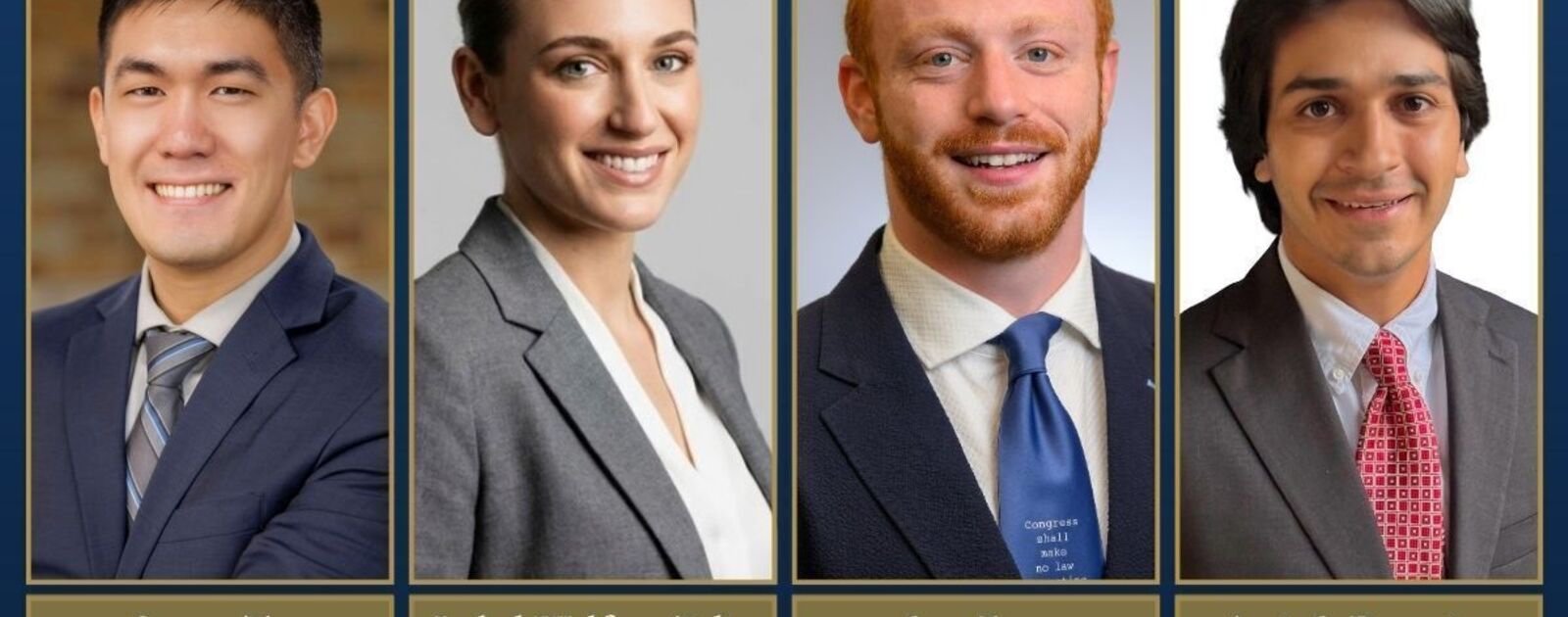
Photo: Notre Dame Law School. The 2026 winners.
Notre Dame Law School's Program on Church, State & Society has named the winners of its 2026 writing competition, four law students and recent graduates from four different law schools, each writing on the free exercise of religion. Notre Dame announced them on 17 June 2026. Our congratulations to all four.
The winners
- First place ($3,000): Steven Tu, a 2026 Notre Dame Law School graduate, for "Replacing Smith: Reconstructing Scrutiny for Free Exercise."
- Second place ($2,000): Isabel Wolfson Zelig, a 2026 Harvard Law School graduate, for "Binding Beyond the State: Defining 'Religion' in the Free Exercise Clause."
- Third place ($1,000): Sam Foer, a rising third-year at Washington and Lee University School of Law, for "Conditions of Belief: Free Exercise, State Action, and the Faculty of Conscience."
- Honorable mention ($500): Amir S. Downing, a rising third-year at the University of Virginia School of Law, for "Religious Land Use Exceptionalism: The Meaning of 'Substantial Burden' in RLUIPA."
"I chose this topic because it brought together my interests in religious liberty, constitutional interpretation, and judicial humility," said Steven Tu, the first-place winner, whose paper proposes reworking the tiers of constitutional scrutiny for free-exercise claims. The four papers together map much of the current debate over the Free Exercise Clause, from what counts as "religion," to how the state shapes the conditions of belief, to the reach of the Religious Land Use and Institutionalized Persons Act.
About the competition
The competition is run each year by Notre Dame Law School's Program on Church, State & Society, which studies how the law structures the relationships among religious institutions, the state, and the wider society; the program is directed by Professor Richard Garnett. The contest is open to law students and to recent graduates not yet practicing, at ABA-accredited law schools across the United States, and asks for a substantial piece of original scholarship of nine to thirteen thousand words. That it drew winners from Notre Dame, Harvard, Washington and Lee, and Virginia in a single year is a sign of how far its reach extends.
Why it matters
Writing competitions like this one are where the next generation of scholars first stakes out a position on hard, unsettled questions, and religious liberty is among the most actively contested areas in American constitutional law right now. A national placement is an early, portable mark of distinction for a young lawyer headed into practice or the academy.
For law students
Students and alumni at these schools can search legal jobs and internships worldwide on LegalAlphabet. Browse current openings on the United States legal jobs board, or read more from our Law School News desk.
Sources
This report is based on the announcement published by Notre Dame Law School. Quotations are drawn from that announcement.
Has your law school's student, graduate, or faculty member done something worth celebrating, an award, a fellowship, a clerkship, a competition win? Tell us and we will put it on the record.