
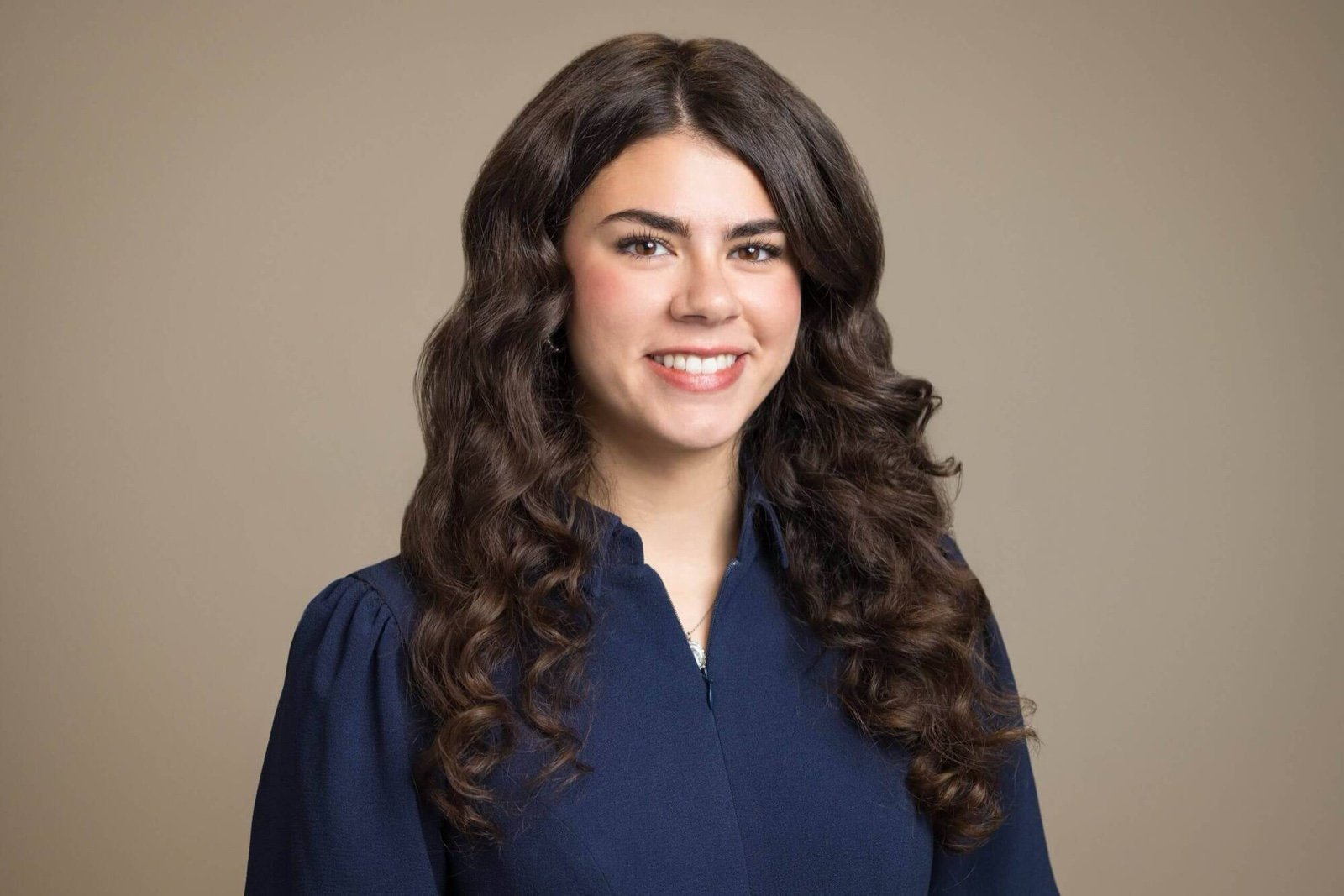
Photo: Notre Dame Law School. Olivia Rogers, JD 2023.
Olivia Rogers, a 2023 graduate of Notre Dame Law School, will clerk for Justice Amy Coney Barrett at the United States Supreme Court during the 2026-27 term. Notre Dame announced the news on 24 June 2026. A Supreme Court clerkship is the single most sought-after credential in American law, and there is a particular symmetry to this one: Justice Barrett is herself a Notre Dame Law graduate who taught at the school for fifteen years. Our congratulations to Rogers, to her professors, and to the school.
"It is truly a dream come true," Rogers said in the school's announcement. "I'm thrilled to have the opportunity to clerk for Justice Barrett." She traced the ambition to her first year of law school: "From day one of law school, I admired Justice Barrett. Watching her walk through the confirmation process was incredibly inspiring as a first-year law student."
Who is Olivia Rogers
Rogers graduated from Notre Dame Law School with highest honors in 2023. At Notre Dame she served as executive articles editor of the Notre Dame Law Review, competed in moot court, was president of the Federalist Society in her third year, and worked in the Lindsay and Matt Moroun Religious Liberty Clinic. She completed her undergraduate studies at Kansas State University.
Since graduating, she has taken the classic route to the Supreme Court. She clerked for Judge Kevin Newsom of the US Court of Appeals for the Eleventh Circuit and then for Judge David Stras of the US Court of Appeals for the Eighth Circuit, two judges widely regarded as "feeder" judges whose clerks regularly go on to the Supreme Court. Between and around those clerkships she practiced at Consovoy McCarthy PLLC in Washington, D.C., focusing on constitutional and election law. Reflecting on the appellate clerkships, she said: "I am so grateful to have worked for two top jurists during my clerkships. Both clerkships offered me the opportunity to consider important legal issues as applied to real-world cases, and taught me to think critically and communicate clearly."
Her former professors were unrestrained. "She was an engaged student, a generous citizen, an admirable role model, and a gifted teacher," said Professor Richard Garnett. "The country and the justices are fortunate that she is contributing, as a public servant, to the work of the Court."
A Notre Dame to Notre Dame story
What makes this appointment more than an individual triumph is who Rogers will work for. Justice Barrett graduated first in her class from Notre Dame Law School in 1997. She clerked for Judge Laurence Silberman of the D.C. Circuit and then for Justice Antonin Scalia, returned to Notre Dame as a member of the law faculty in 2002, and taught there until her appointment to the Seventh Circuit in 2017. When she was confirmed to the Supreme Court in October 2020, she became the first Notre Dame alumna, and the first member of the Notre Dame faculty, to sit on the Court.
Since reaching the bench, Justice Barrett has repeatedly drawn her clerks from her old school. Rogers will be at least the fourth Notre Dame graduate to clerk in Barrett's chambers, following Timothy Bradley (JD 2020), Kari Lorentson (JD 2019), and Elizabeth Totzke (JD 2022). Rogers, who began law school the same semester Barrett was confirmed, now completes the circle.
The school as a whole has become an unlikely Supreme Court pipeline. In its announcement, Notre Dame noted that Rogers "will be the sixth graduate to clerk at the U.S. Supreme Court in the last five years." Counting from the 2019-20 term, at least nine Notre Dame graduates have clerked at the Court, serving justices across the bench. For a law school outside the traditional handful that dominate Supreme Court hiring, that is a striking record.
What a Supreme Court clerkship actually is
To understand why this is such a milestone, it helps to know what the job involves and how few people ever hold it.
Each of the nine justices may hire up to four law clerks per term, a number Congress authorized in 1980. That means roughly 36 clerks serve in any given year, a few more when retired justices or the Chief Justice's extra staff are counted. Clerkships run for a single year, tracking the Court's term, which opens on the first Monday in October, 5 October in 2026, and runs into the following summer.
The work sits at the center of how the Court operates. Clerks help process the roughly 5,000 to 6,000 petitions the Court receives each year asking it to hear a case. Most chambers pool that work: clerks split the petitions and write shared "pool memos" recommending whether to grant or deny review, with a single clerk often drafting several such memos a week. For the small number of cases the Court agrees to hear, clerks prepare bench memos analyzing the issues before oral argument, and they assist in researching and drafting the Court's opinions and orders. The Court publishes a short overview of the role on its own law clerks page.
The positions are extraordinarily competitive. In a typical year, only a few hundred graduates nationwide clear the informal bar, top grades at a leading law school, a law-review editorship, and at least one federal appellate clerkship, and well over a thousand apply. From that pool, only about three dozen are chosen. The credential opens nearly every door in the profession afterward: many former clerks command signing bonuses of roughly $400,000 to $500,000 at large law firms, while others move into legal academia, the Solicitor General's office, or elite appellate practices.
The path Rogers took
Rogers's résumé reads like a template for how the clerkship is actually won. A leading law school? Notre Dame, with highest honors. A law-review leadership role? Executive articles editor. Federal appellate "feeder" clerkships? Two of them, on the Eleventh and Eighth Circuits. Appellate practice in her field? Constitutional and election law at a specialist Washington firm. Each rung is exactly the kind of step that Supreme Court clerks tend to have climbed, and it is the same broad path Justice Barrett herself once followed, from feeder clerkships to the Court.
Rogers framed the achievement in the language of Notre Dame's motto, "a different kind of lawyer." "To me, being a different kind of lawyer means looking at the law as a vocation," she said, "and considering how best to use the gifts and opportunities you have to serve others."
For Notre Dame law students, and anyone chasing a clerkship
Clerkships, at every level from state trial courts to the Supreme Court, remain one of the strongest launchpads in a legal career, and they are open to far more students than the handful who reach One First Street. Notre Dame students and alumni can search legal jobs and internships worldwide on LegalAlphabet. See legal jobs in Indiana, or browse current openings on the United States legal jobs board. For more student and graduate achievements, see our Law School News desk.
Sources
This report is based on the announcement published by Notre Dame Law School, with additional background from the public records of the Supreme Court of the United States and the federal judiciary. Quotations are drawn from the Notre Dame announcement.
Has your law school's student, graduate, or faculty member done something worth celebrating, a clerkship, a fellowship, a competition win, an appointment? Tell us and we will put it on the record.